

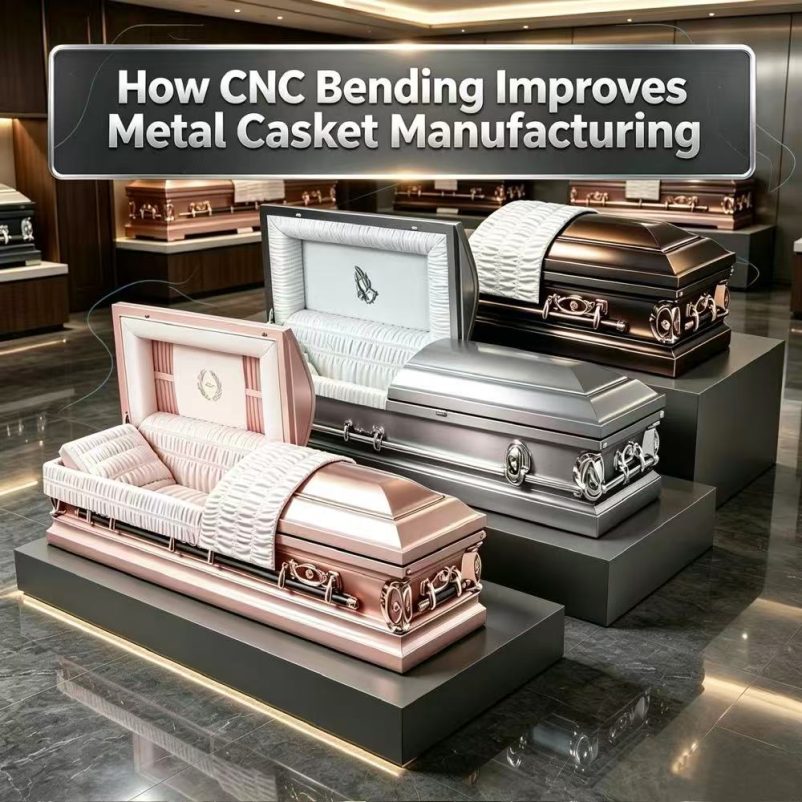
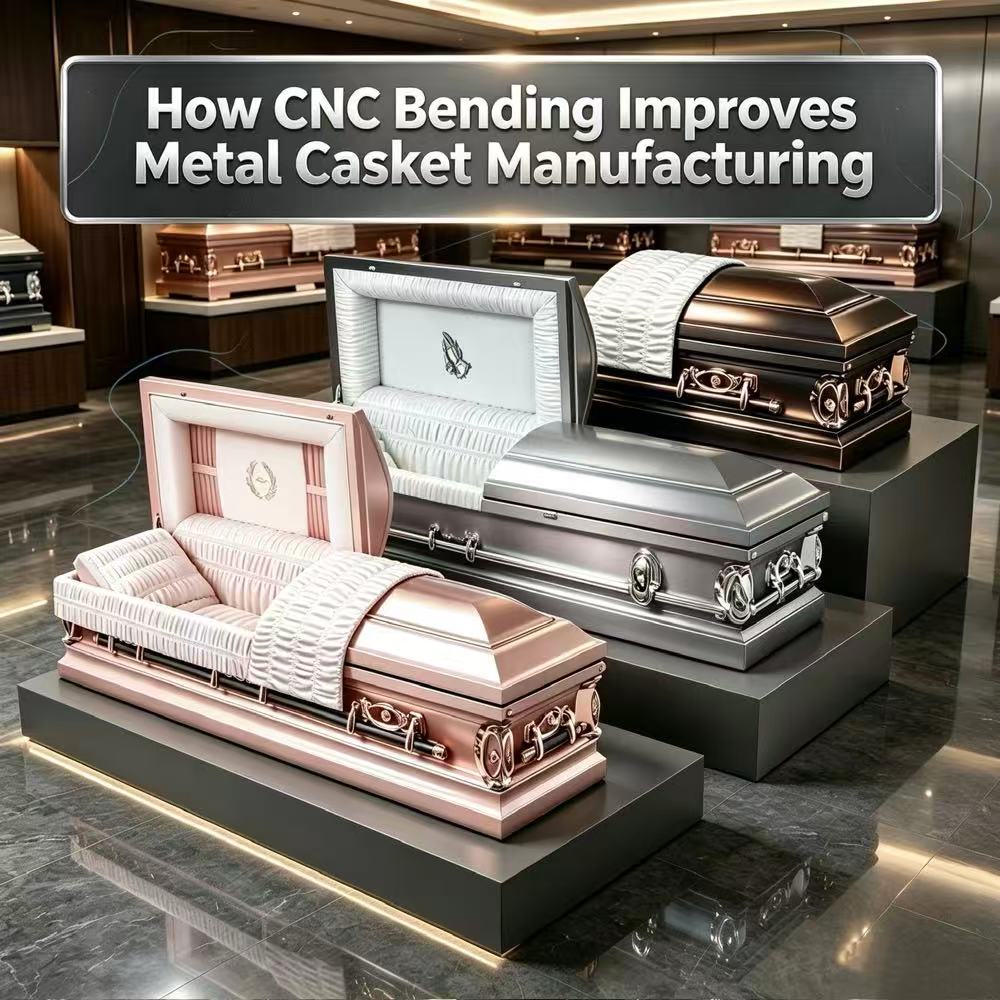
Metal caskets rely on precise metal forming to achieve clean, symmetrical profiles, tight seam fits and consistent outer contours. Manual bending introduces variability that is hard to control across bulk orders. CNC bending brings automated, programmed forming to metal casket production, directly stabilizing product quality and streamlining batch output. You can also read our related guide: How Laser Cutting Is Used in Metal Casket Manufacturing to learn about the upstream cutting process.
What CNC Bending Does for Metal Casket Production
CNC bending (computer numerical control bending) uses pre-programmed parameters to fold metal sheets into the required panels, side frames, lid sections and base components for metal caskets. Once the program is set, the press brake repeats the same bending sequence for every workpiece.
Core Benefits
1. Consistent Angles
Every bend angle follows the programmed value. For casket panels, uniform angles ensure all sections align perfectly during assembly. This avoids gaps, uneven joints or twisted profiles that often appear with manual bending. Even for custom-size caskets, each matching panel maintains the same angular specification.
2. High Repeatability
For bulk wholesale and OEM orders, repeatability is critical. The same bending program can run hundreds of identical casket parts. Distributors and importers receive batches with matching geometry, which is essential when you order repeated restocks or private-label lines. Parts are interchangeable, reducing assembly rework at the factory.
3. Better Forming Quality
Controlled, gradual pressure from CNC press brakes minimizes scratching, denting, wrinkling or material tearing on coated and polished metal surfaces. Smooth, clean bends deliver crisp, sharp lines on the finished casket exterior. This directly lifts the premium visual finish that funeral home buyers look for. It also helps preserve paint and powder coating integrity around folded edges.
4. Higher Production Efficiency
After program setup, the bending cycle runs automatically. It cuts down the time spent on manual measurement, adjustment and trial bends. The factory can process more panels in less lead time, supporting larger order volumes and faster shipment schedules for importers.
How CNC Bending Shapes the Final Casket
The bending quality impacts multiple visible and functional parts of the finished metal casket:
• Outer shell panels: Straight, symmetrical sides and lids
• Frame joints: Tight-fitting seams for stable assembly
• Recessed sections for decorative hardware and handles
• Base contour that matches the casket lid profile
Poor bending leads to misalignment, difficult installation of trim/hardware, and cosmetic defects that are obvious on display. Reliable CNC forming creates a solid foundation for the later QC, polishing and coating steps.
Practical Notes for Buyers
When evaluating a metal casket manufacturer, you can ask whether they use CNC press brakes for forming. For custom casket designs with unique curved or angled panels, confirm if the factory can save your bending program for future reorders. CNC bending works best paired with laser cutting: laser cutting delivers accurate blank sheets, and CNC bending turns those blanks into uniform formed parts.
Closing
CNC bending is a foundational forming process for high-quality metal caskets. It removes human inconsistency, stabilizes visual quality and supports scalable bulk OEM production. Combined with laser cutting, it gives manufacturers the ability to produce both standard and custom metal caskets reliably.