

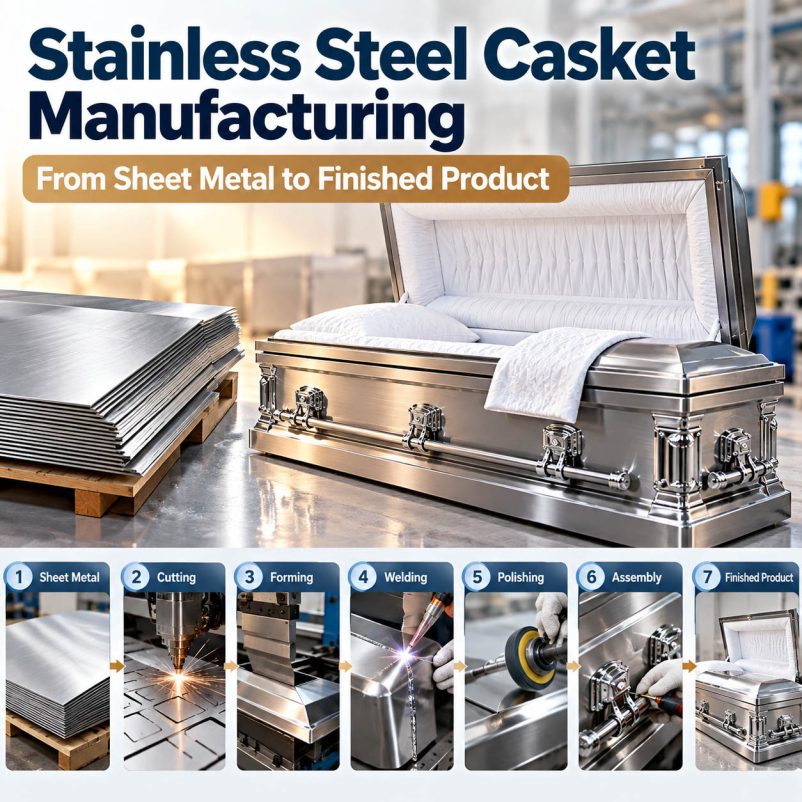
Note: This article focuses on production process. For material grade, gauge, and construction parameters, please refer to our Stainless Steel Casket Buying Guide.
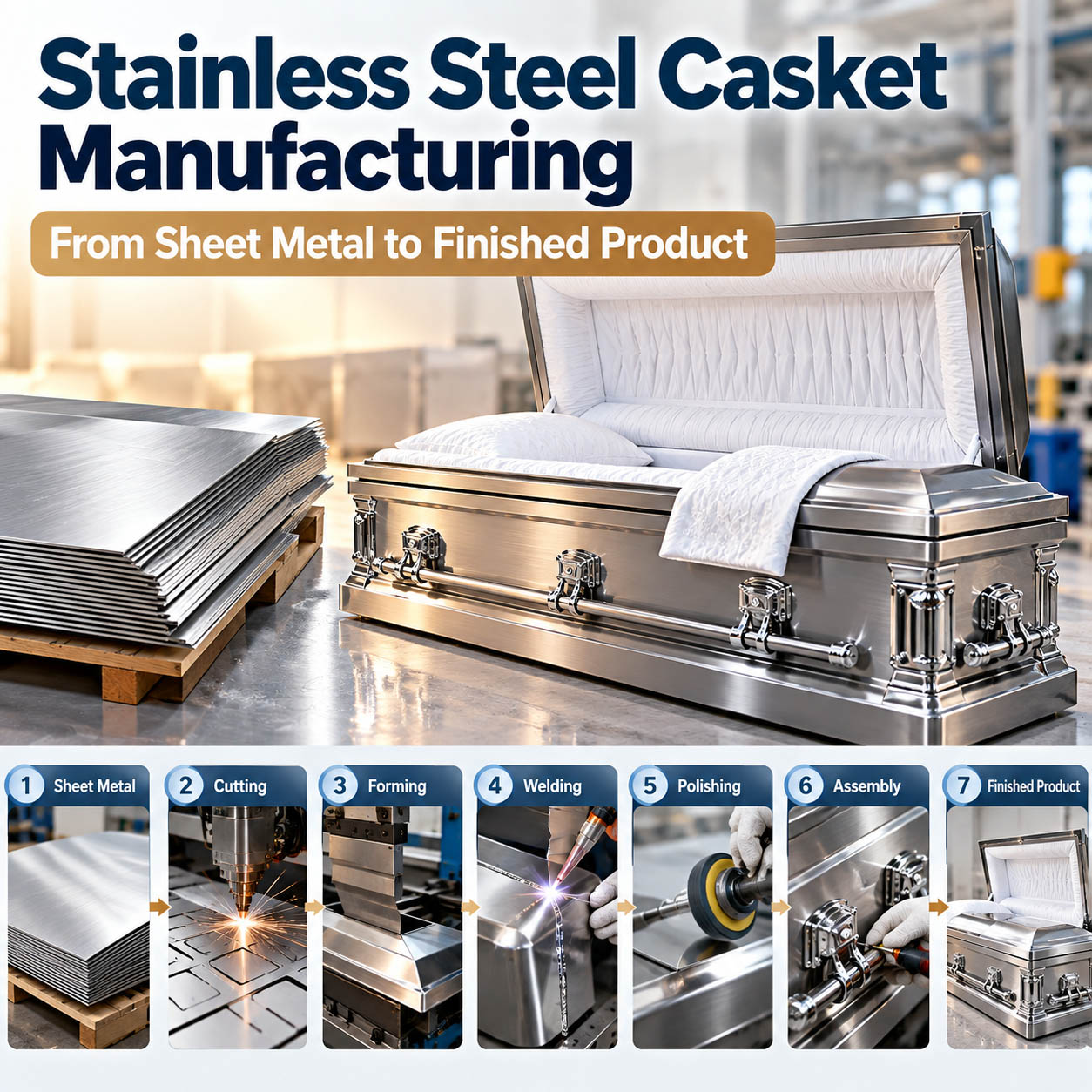
Step 1: Sheet Preparation & Material Verification
Production begins with incoming stainless‑steel sheet stock.
• Raw sheets are inspected against material certification to confirm alloy grade (201 / 304 / 316) and actual gauge thickness, to avoid mismatched material.
• Sheets are inspected for surface defects, scratches, or rolling imperfections before entering fabrication.
• Sheets are cut to standardized blank sizes for casket body, lid, end panels and reinforcement parts.
This incoming‑material check is foundational: improper material grade or wrong gauge will undermine corrosion resistance and structural strength, even with perfect downstream processing.
Step 2: Laser Cutting
Flat blanks are processed on laser‑cutting equipment to produce precise component profiles for the casket shell, lid, corner reinforcements and mounting holes for hardware.
• Laser cutting delivers clean, burr‑free edges and accurate hole positioning for hinges, handles and locking mechanisms.
• High‑pressure assist gas is used to minimize edge oxidation, reducing post‑processing grinding work.
• All cut‑out parts are matched to production drawings, with dimensional checks to ensure parts will fit together in later assembly.
Step 3: Bending
Flat cut blanks move to CNC press‑brake bending stations to transform 2‑D flat sheets into 3‑D casket‑shaped components.
• Technicians compensate for stainless‑steel springback to achieve consistent bend angles for side walls, rim flanges and lid frames.
• Proper bend‑radius selection prevents cracking or material tearing along bend lines.
• After bending, each part is measured for dimensional accuracy before moving forward.
This step defines the core shape of the casket shell and lid; inconsistent bending leads to poor fit‑up during assembly.
Step 4: Forming & Structural Reinforcement
Forming operations shape panels into the final contour of the casket body and lid.
• Reinforcement keel parts are formed separately for bottom and side‑wall strengthening. These reinforcing elements improve load‑bearing performance and reduce deformation during transport and storage.
• Panels are fixtured to hold alignment during subsequent joining work.
• All formed parts undergo visual and dimensional checks for warping, distortion or edge damage.
Step 5: Welding & Assembly
Welding is one of the most critical stages for stainless‑steel casket quality. Two primary welding approaches are used, depending on product specification:
1. Full‑seam welding (premium models): Continuous welding along all shell and lid joints. Welding fixtures are used to control heat input and minimize thermal warping, a common risk with stainless‑steel fabrication. After welding, weld beads are ground smooth to eliminate sharp edges and improve sealing performance.
2. Spot welding (entry‑level models): Selective spot‑weld joints at key connection points, with lower production cost.
Following welding, the casket shell and lid are dry‑fit together to verify alignment, hinge‑mount positions and closure fit. Hardware mounting holes are confirmed for proper alignment.
Step 6: Surface Finishing
After metal‑shell assembly, the casket moves to surface‑finishing work, which directly affects aesthetics and corrosion performance.
• First, the shell is thoroughly cleaned to remove welding residue, oil and metal debris.
• Depending on customer specification:
◦ Brushed satin finish: Uniform brushing across surfaces for a low‑sheen, scratch‑tolerant matte metal look.
◦ Mirror polish finish: Multi‑stage polishing to create high‑gloss reflective metal surface.
◦ Electroplated / painted finish: For custom‑color options, specialized coating processes are applied after base‑metal preparation.
• Optional passivation treatment is applied to restore the stainless‑steel passive protective layer, improving long‑term rust resistance after fabrication work.
Important: Poor finishing can compromise corrosion resistance even with high‑grade stainless‑steel material.
Step 7: Interior Installation
Once the exterior metal shell is complete, interior components are fitted.
• Interior lining materials (satin, velvet, non‑woven fabric) are cut and fitted to the casket interior.
• Padded bed bases, built‑in pillows and securing straps are installed.
• Interior trim and decorative edging are fitted neatly.
• For custom orders, embroidery or special fabric treatments are completed at this stage.
Step 8: Hardware Fitting
All functional and decorative hardware is mounted: handles, hinges, locking mechanisms and ornamental trim pieces.
• Hardware is secured to pre‑drilled mounting points.
• Hinges are adjusted for smooth, consistent opening and closing of the lid.
• Lock mechanisms are tested for reliable operation.
Step 9: Final Quality Control (QC)
Every finished casket goes through multi‑point QC before packaging:
1. Dimensional check: Overall length, width, height and critical fit dimensions are verified against production drawings.
2. Structural check: Inspection of all welds for porosity, cracks or incomplete seams; check for shell warping or deformation.
3. Surface inspection: Exterior surface for scratches, dents, uneven polish or brushing defects.
4. Functional test: Hinges, locks and handles are operated to confirm proper function.
5. Corrosion‑ready check: Confirm no residual metal contaminants that could cause premature surface discoloration.
6. Final visual inspection of interior fit, fabric quality and hardware alignment.
Qualified units are packed for shipping; non‑conforming pieces are sent for rework.
How Manufacturing Choices Impact Your Purchasing Decision
• Full‑weld construction, heavy‑gauge sheet and proper surface passivation directly translate to better long‑term durability, especially for humid or coastal environments.
• Brushed‑satin finishes are more forgiving of minor handling marks than mirror‑polished surfaces.
• Standard production models follow this established workflow; custom‑specification orders may add extra processing steps for special interior, plating or hardware requirements.
FAQ
Q1: Does a full‑welded casket mean zero possibility of corrosion?
A: Full‑weld construction improves sealing and structural integrity. Corrosion risk still depends on stainless‑steel grade and environmental exposure. Proper finishing and passivation are required to preserve material performance.
Q2: What is the difference between spot‑weld and full‑weld caskets in production?
A: Spot‑weld models have fewer continuous weld seams, lower production cost. Full‑weld models have continuous sealed seams for improved moisture‑barrier performance, and are used for mid‑to‑high‑end product lines.
Q3: Can I request custom modifications to standard production caskets?
A: Yes. Custom options include exterior finish, interior fabric, embroidery and hardware selection. Custom orders may require additional production lead time.
Closing
Our stainless‑steel casket production follows this end‑to‑end manufacturing workflow, with rigorous material verification and multi‑stage quality control. To explore our full range of standard and customizable stainless‑steel casket models, please visit our Stainless Steel Casket Product Page.